October 09, 2026


A spare room rarely has just one job. It is an office, a drying room, a home for the ironing board and the Christmas decorations. Then someone comes to stay, and you remember it also needs to sleep a person. A sofa bed and a daybed both promise to solve that, but they go about it differently. One unfolds into a bed and folds back into a sofa. The other is a bed that behaves politely as seating. The right answer comes down to four things: comfort, footprint, cost and how your guests actually use the room.
A sofa bed is a sofa first. Inside it there is a mechanism — click-clack, pull-out, or a folding frame — and a mattress that either folds in half, rolls up or sits on a metal grid. When it is not in use, it looks like seating. The compromise is built in: something has to fold, and that something is usually the mattress.
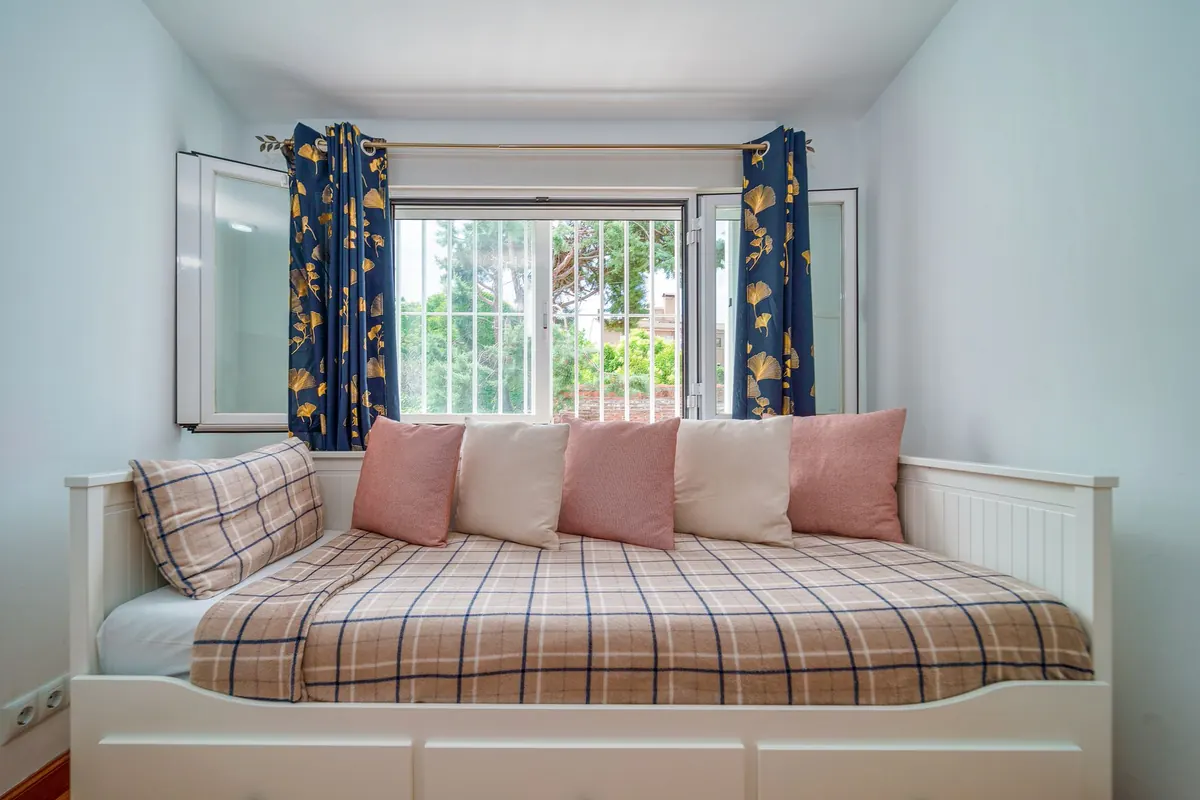
A daybed is a bed first. It is a single bed frame with a back panel at one end or along one side, sometimes with arms at both ends. You sit on it with your back against that panel and your feet along the length. At night, the cushions come off and you sleep on the same surface. There is no mechanism to go wrong, which is why daybeds tend to feel more solid — and why most of them are single-sized.
The usual complaint is the bar or frame under the mattress. On a pull-out model you feel the metal support grid through a thin mattress. On a click-clack, the fold line runs across the middle of your back. If the sofa bed will be slept on more than a handful of nights a year, look for a sprung mattress rather than plain foam, and check how thick the mattress is before you buy. A good mattress topper is the single cheapest improvement you can make to any guest bed, and it travels with you if you upgrade the furniture later.
A daybed takes a standard single mattress, which means you can buy a proper one — the same mattress you would put in a child's room. Support is even, there is no bar, and a tall adult can sleep comfortably on it provided the frame takes a full-length single mattress. The catch is width. A single is around 90cm across, which is fine for one person and hopeless for two. A double daybed solves that, but it takes up double the floor space, at which point a conventional bed is often the better buy.
A sofa bed wins on seating, without much argument. Proper arms, a sprung seat, a real back. A daybed's back panel is usually lower and firmer, so it works best piled with cushions — lovely for a reading corner by a window, less comfortable for a three-hour film.
This is where the two pieces part company most sharply. A sofa bed only occupies its footprint some of the time; the rest of the time it needs a clear run of floor in front of it. A two-seater that is around 90cm deep will open to somewhere near 190–200cm deep, and it will need that space clear of the bed, the desk, the wardrobe doors and anything else in the room. Most two-seater sofa beds also make up into something narrower than a standard double bed, so measure the sleeping surface, not just the sofa.
A daybed takes up its space permanently but predictably: roughly 95cm by 200cm for a single, plus a little clearance for getting in and out. That suits a narrow room or a box room well. Push it along the long wall, or into an alcove beside a chimney breast, and you keep a decent walking route through the middle of the room. Check door swings, radiator positions and window handles before you commit.
Sofa beds cost more to make and more to buy. There are mechanisms, hinges, frames and springs, and more parts mean more to go wrong. At a comparable level of quality, a daybed is usually the cheaper purchase because you are buying a simple frame and a mattress separately.
Think about the long term, too. Daybeds take standard mattresses, so when one sags after five or six years you replace it without touching the frame. Sofa bed mattresses are often made to fit a particular model and cannot easily be swapped, which means the whole piece gets replaced when the mattress gives up. Delivery and assembly also vary: some furniture arrives flat-packed and kerbside, with assembly charged separately, so read the small print before ordering and check the returns policy in case the measurements don't work out.
Measure the route before you measure the room. A sofa bed is heavy and often arrives in one piece, so it has to clear the front door, the hall, the turn at the top of the stairs and the bedroom doorway. If the turn is tight, a flat-packed daybed is far easier to manoeuvre.
Storage matters more than most buyers expect. A daybed with under-bed drawers swallows spare duvets and pillows, which is useful when the room has only one wardrobe. A sofa bed usually gives you nowhere to put the bedding except on top of it.
Think about the mattress depth, too. Deep mattresses and standard fitted sheets are a bad pairing, and a topper adds another few centimetres. Buy one set of bedding in the right size and keep it with the bed.
Whichever you choose, put the money into the mattress and the mechanism, because those are the two things you will notice on the second night. Measure twice, keep the receipt, and remember that a spare room used for eleven months as a study deserves furniture that works for the other eleven months — not just for the week your guests arrive.
Small ideas for cozy corners and compact homes.
Copyright © 2026 Nook Bit. All rights reserved. Nook Bit.